• Wednesday, April 11, 2012

    Sausage and Legislation.

    What are two things that you don’t want to see being made? Sausage and legislation.

    Thanks to CSPAN, CNN, MSNBC, and the 24-hour news cycle, we get to see legislation being made (or not made) all the time. So, we might as well learn about sausage, too.

    One day last week, we spent all morning working in the meat lab making sausage, and I snapped a few pictures and decided it would make a fun and informative blog post.

    First, why even bother making sausage?
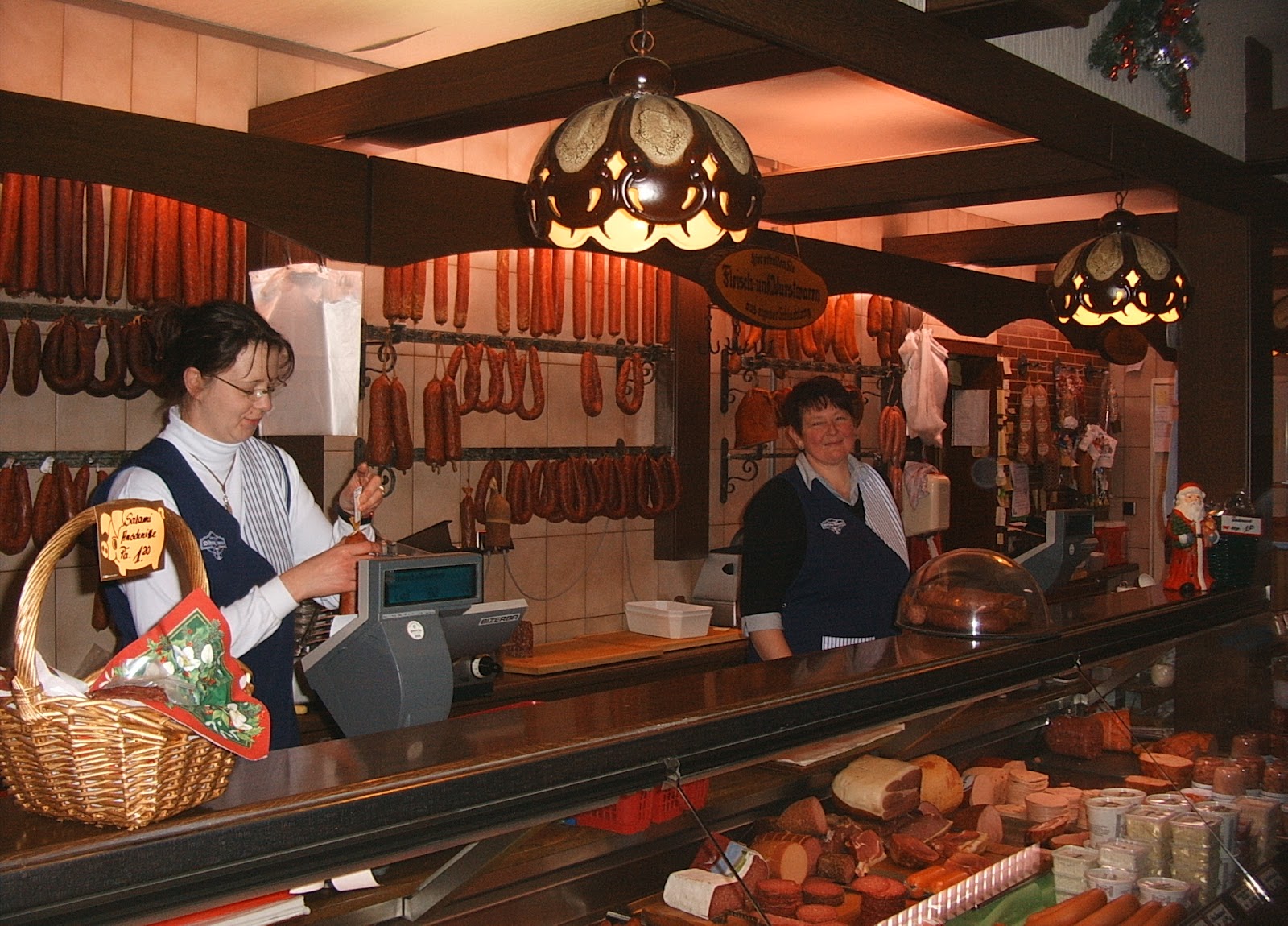
    
    We went to Germany a few years ago and
    tasted several German sausages. Yum!
    You mean, besides tastiness? Sausage making has been used for hundreds of years to preserve meat. When salt and spices are added, it takes it longer for meat to spoil. Some sausages are very dry and acidic (think summer sausage and pepperoni). Bacteria can’t survive such conditions. Some sausages have been smoked to preserve them. The heat and the compounds from the smoke both serve this purpose.

    Today, sausage allows meat producers to add value to low-value cuts and to efficiently use every piece of the carcass. Old-time butchers used to say that when you harvested a pig, you used “everything but the squeal”. When you cut up a beef or pork carcass into steaks, chops, and roasts (and bacon, don’t forget bacon), there is always meat left over. The extra meat is ground through a grinder that cuts it into small pieces, making even the toughest meat fork-tender. I talked a little about this in the “not pink slime” and the “cooking burgers” posts. There is fat trim and lean trim.

    Here are pictures of our fat trim and lean trim.


    You could just grind it and mix it and cook it up, but how boring. Let’s make something more exciting!

    The fat trim was about 50% fat and 50% lean and was made mostly from belly pieces that we decided not to make into bacon. The lean trim was about 93% lean and 7% fat. It was made from ham pieces and pork chops that we had removed samples from. We mixed them together in a specific ratio to make sausage that was about 80% lean and 20% fat. You don’t want to make your sausage too fatty (for obvious reasons), but you also don’t want it to be too lean (it would be tough and dry).

    Side notes:

     ***In the US, pork sausage can be 50% lean and 50% fat and still be labeled pork sausage. Generally, commercial sausage is not that fatty because consumers want a leaner product.

    *** All of our sausage was made from pork skeletal meat. There are sausages made from liver or hearts or even salivary glands, but remember that if it’s in the sausage, it has to be on the label.


    We put our ground pork in a big mixer and added the salt and spices. We buy most of our spices pre-mixed, but sometimes we mix our spices from a recipe.

    This is where it gets cool.

    Muscle is made up of protein. To do what proteins need to do in the body, they exist in long, folded-up chains. When you add salt to meat, the salt reacts with the protein and starts to dismantle it on a molecular level. As the proteins unfold, they start to stick to each other. They stick to everything, even water. We added water to the sausage in the mixer, and the protein soaked it up like a sponge.

    This is the andouille on my glove. Looks yummy. See how it sticks to my glove.

    Some of the sausage recipes include cheese. We can’t just use regular cheese. We have to use a special, high-melting temperature cheese. If the cheese melted, you wouldn’t be able to see it in the finished sausage
    We added in the cheese as the sausage was mixing.


    This is some Jalapeno cheese sausage. You can see the cheese and the jalapenos in the finished product. Yum! I didn’t take this picture. It was on the website of my late friend, Chris Raines, called Academic Abattoir.


    Notice that Chris’ sausage was pink? Some of the sausage recipes call for the addition of cure (Sodium Nitrate). This gives the sausage it’s pretty pink color and cured flavor. Yum.

    After mixing it for about 2 or 3 minutes, we grind the sausage again.
    We always hold the meat in sanitized containers like this one. We call these ‘lugs.’ I don’t really know why. I guess because you have to lug the meat around in them.


    Then we moved the sausage to the stuffer which is kinda like a vacuum in reverse. You fill it up with sausage and a piston pushes the sausage up through a tube, called a horn. The size of horn dictates how much sausage comes out at once.


    This is a picture of some sausage in the stuffer.
    We stuffed some of our sausage into chubs. This was the recipes we weren’t going to smoke, like breakfast sausage, some Italian sausage, and maple-flavored sausage.
    
    This is another one of Chris' pictures.
    These are sausage chubs.
    

    We stuffed some of the sausage into natural casings. What are natural casings? Remember when I said that we use everything, but the squeal? The best sausage casings are made from pig intestines. They are washed and washed and washed and cleaned and treated and washed some more.

    Before we stuffed them, we soaked them in water to hydrate them and flush them out one more time.


    Here is what the casings look like in a package.

    If you buy sausages in the store that have been stuffed into natural casings, it will say so on the package.

    The casing goes over the horn, and the stuffer pushes the meat into the casing. It makes a long tube of meat. You can see the cheese in our sausage in this one.


    I have a video of our meat lab manager stuffing the sausage into the natural casing.


    After the sausage is stuffed in the casing, you have a long tube of sausage that looks like this.


    If we left the sausage like this, it would be very hard to handle in getting it smoked and cut into serving-size pieces. So, we linked it.

    To link the sausage, we pinched the sausage casing and twisted it. You have to alternate the direction that you twist the casing or you will untwist previous links. In big commercial sausage plants, they have machines that link the sausage as it comes out of the stuffer.

    I have a video of linking, too.


    This is what the linked sausage looked like. This was some of our jalapeno, cheese recipe.

    We allowed it to rest in the cooler overnight. That gave the protein a little extra time to soak up the flavors of the spices.


    The links all stay attached to each other until we cook it. When it’s cooked, the sausage links are hung over a metal stick and hung in the smoke house. In the smokehouse, they are cooked with heat and smoke is applied to give the sausage that nice smoky flavor. Yum.


    This is a picture of a couple of students at a processed meats workshop from about 5 years ago. They are not my students, but I think that they are now both gainfully employed. You can see the linked sausage ready to go in the smokehouse.

    This is a picture of our finished product. It was quite tasty!

    This is just the tip of the iceberg when it comes to sausage making. There are so many other neat things to talk about, like fermented sausage, different casings, hot dogs, canned sausage, pickled sausage, and other cooked meat specialties, but I guess that will all have to wait for another day’s post.

    Friday, March 23, 2012

    How would you like that cooked?

    You order steak or a burger at a restaurant and the waiter or waitress asks, “how would you like that cooked?” What is your response? Well, if you are ordering a steak, there is no wrong answer to that question. HOWEVER, you should ALWAYS order hamburgers or any other ground meat dish cooked to medium, medium well, or well done. I always order mine medium well.

    Why should hamburgers be cooked to medium well, but steaks can be cooked to rare?

    Today, I visited a Family and Consumer Science Class and demonstrated to them the answer to this question with play-doh. (I had to fight the little Daughter at the Meat Counter off the play doh.) I took some pictures to share on my blog.

    When steaks are cut, there is a possibility that bacteria (disease-causing germs) could be on the surface of the steak. Steaks (and roasts, too) are whole-muscle cuts, meaning that they have been cut into serving- or cooking-size pieces, but the internal portion of the cut is still undisturbed. So, those bacteria are going to only be on the surface of the steak, and when you cook it, the surface will be the first to get hot and it will get the hottest. Any bacteria on the surface are going to be killed in the cooking process. The internal part of the meat does not have to get hot enough to kill any bacteria. So cooking steaks to rare or medium-rare is perfectly safe.


    Do you like my little play-doh steaks? The green dots are the bacteria (only on the surface). The Daughter at the Meat Counter thought they were peas.

    Ground beef is made from smaller cuts of beef that are trimmed away from the steaks and roasts. They are not lower quality or inferior in anyway other than they are too small or too tough to make good steaks are roasts. (Actually, which parts are cut into steaks and roasts and which parts are ground into hamburger is largely driven by ground beef demand. People like hamburgers.) These parts and pieces (trim) are kept in large containers and transported to the grinding room in the plant. All of these little pieces could have bacteria on their surfaces just like the steaks above. Several companies have researched different ways to treat the trim pieces to lower the bacterial count on the surface.


    Here is my play-doh trim. It’s smaller and cut into irregular pieces. The bacteria are still only on the surface.

    Here is where the difference is. The trim is ground. When meat is ground, it is pushed through a metal plate with small holes. Behind the plate, is a rotating knife that cuts the meat and allows it to be pushed through the plate.


    This is not play-doh. I actually have pictures of real meat! Yay! You can see the round strands of ground beef coming through the plate.

    Now, any of those bacteria that were on the surface of the meat are mixed up and spread all throughout the ground beef. When we make patties out of the ground beef, the bacteria could be on the surface or anywhere inside the patty.

    These are some patties we made for a research project. Real bacteria don’t have color and you can’t see them on or in your patties.
    It is easier to see the green, play-doh, bacteria mixed in with the red in my play-doh patty.
    When I tore open my little play-doh patty, the students could see the green bacteria all throughout the patty.

    So, when you cook patties, you should always cook them to 160 °F. USE A MEAT THERMOMETER. Make sure the thermometer is inserted into the middle of the patty.

    When you order hamburgers at a restaurant, ALWAYS order them to medium or greater.

    If you have other questions about food safety, I wrote a blog post about food safety in September.

    A common conversation over steak dinners with meat scientists is how we order our steaks. I order my steaks cooked to medium-rare. Why, you ask? Well, there are two main types of protein in meat that affect tenderness, connective tissue (holds it all together) and myofibrillar (causes the muscle to contract). These two proteins react differently to exposure to heat. Connective tissue (collagen) protein dissolves to gelatin when it is heated, so it becomes more tender. The myofibrillar proteins harden as they are heated and become tougher. The optimum combination of collagen dissolving and myofibrillar hardening happens at about the temperature of medium-rare. Yum.

    Some people don’t like the serumy (bloody) flavor associated with medium-rare and they want their steaks cooked longer (my mom). I guess that’s ok. If you like more well done steaks, I suggest you buy steaks with more marbling (USDA Choice, Prime, and Certified Angus Beef). The extra marbling protects the tenderness of those steaks when you cook them more.

    Like I said, there is really no wrong answer to the question, “how would you like your steak cooked?”

    However, you must cook hamburgers to medium (160°F) or greater.

    Friday, March 9, 2012

    We are not really talking about pink slime

    What a lovely way to title a blog post! Pink slime! Wednesday night, ABC news reported a story about a product that is found in many ground beef products. They reported that a ‘whistle-blower’ USDA employee has come out telling the world about the evils of ‘Lean Finely-Textured Beef.’ This former USDA microbiologist, coined the term ‘pink slime.’ Celebrity chef, Jaime Oliver has falsely reported about this product in the past, too. He is so off-base and his approach is so theatrical, I couldn’t even bear to link to his video. 

    Since the ABC report, other news agencies have picked it up and informed us that Lean Finely-Textured Beef is in school lunches and in lots of the beef in grocery stores. The videos and the story links have been lighting up my facebook and Twitter feeds for the better part of two days. 

    First, what is ‘Lean Finely-Textured Beef?’

    What the media is calling pink slime, we, in the industry, call “Lean Beef Trimmings” or “Lean Finely Textured Beef”. I’ve done research with the stuff, and I didn’t think it was slimy at all. This is a picture of the LBT that we used for a research project last fall.
     
    It is kinda pink. News flash: meat is usually a pink or red color! It doesn’t really look like the typical ground beef in the grocery store because it is ground up much finer than that. It is also shipped frozen. It may be shipped in big frozen blocks, but we ordered it in this chipped version so we could weigh it out more easily.

    How is it made?

    When cattle are harvested and cut into the beef steaks and roasts that we buy at the grocery store or that restaurants buy, pieces of lean and fat are trimmed away. Some of that lean and fat can be used to make ground beef and other sausage products. But, some of it is too fatty for ground beef and sausage. There is still lean protein in the fatty parts, but, before the Lean Finely-Textured Beef process came along, there was not really an economical way to remove the lean protein from the fatty trim. So it was thrown away.

    Several years ago, a company called Beef Products Inc., patented a method to remove the lean tissue from the fatty trim. That way, the lean protein is not wasted and we are getting more protein out of every animal.

    So, how does it work?

    They start with fatty trim that is about 80% fat and 20% lean protein. These trimmings were sampled and tested by USDA for harmful bacteria before they arrived at the plant. The trimmings are heated it to about 100°F so that the fat will soften. Then, it is spun in a big mixing bowl machine to separate the lean from the fat.

    The lean is then treated with a puff of ammonia gas and the ammonia reacts with the water on the product and converts it to ammonium hydroxide. This treatment has been one of the hot-button issues for this whole process. Ammonia gas and ammonium hydroxide are not the same as the house-hold cleaner, as a certain celebrity chef wants you to believe. The gas treatment raises the pH of the meat and destroys the bacteria on the meat. (Dead bacteria can’t make your kids sick.) Essentially, the ammonium hydroxide makes the product even safer.

    Ammonium hydroxide is found naturally in some foods and other foods, such as baked goods, cheeses, caramels, chocolate, gelatins and puddings, contain ammonium hydroxide. Here is a video interview with Dr. Gary Acuff from Texas A&M talking about the addition of ammonium hydroxide to lean beef trimmings.

    So, it’s safe?
    The final product is tested for deadly bacteria before it leaves the plant. Countless scientists agree that this product is safe and is produced using a safe process. This article lists several of those scientists and statements they made about the safety of this product. These are microbiologists from Texas A and M University, scientists from USDA, a former president of the National Consumer League, and the nation’s leading food borne illness attorney.

    What products contain LBT?
    When LBT is made, it contains 95% lean protein or greater. So, it is added to ground beef to increase the lean percentage. Because of its fine texture, it can only be added in a small percentage or it will affect the texture of the ground beef. ABC reported that 70% of ground beef in grocery stores contain LBT. So far, I haven’t been able to confirm or deny that number. I couldn’t find the link to cite, but I believe that McDonald’s stopped using LBT because the finely textured properties didn’t work in their beef.


    Is it on the label?

    No. It is 100% beef. Lean Beef Trimmings is not listed as a separate ingredient on the label.

    Obviously, I am not the only person writing about this. There are several other blogs and articles to read.
    The American Meat Institute has a list of questions and answers about the process. My new twitter friend, Travis Arp, a graduate student at Colorado State, has seen the product being made and writes about it in this blog post. (New additions on Monday, March 12, 2012 - pinkslimeisamyth.com and a blog entitled Common Sense Agriculture)Beef Products Inc. has issued a statement about all the recent publicity. And, of course there is the Meat Myth Crushers video. The list could go on and on.


    3-28-12 amendment: Since I posted this, several more websites and articles have been posted telling the real story about Lean Finely-Textured Beef, ammonium hydroxide, and the safety of this product. I felt like I needed to add them to this post.
    • A video about the misrepresentation by Jaime Oliver.
    • A video about the use of ammonia in foods.
    • A interview with Dr. Thomas Powell, Executive Director of the American Meat Science Association (a personal friend of mine). This is a great explanation of this product.
    • A statement from the American Meat Institute President, J. Patrick Boyle.
    • A blog post by agriculture advocate, Trent Loos. (One huge step backwards for mankind.)
    • Several website links are available on the website beefisbeef.com.
    • A heart-wrenching article by Nancy Donley, president of STOP food borne illness. Her only child, Alex, died from kidney failure after consuming hamburger contaminated E. coli O157:H7.
     
    Please read or watch some of these resources and share the truth with people you know.

    Here is the bottom line on my thoughts about Lean Beef Trimmings.

    Yes, it is safe. It is treated to kill bacteria.

    Yes, it is wholesome. It is protein, that, without this process, we would not have access to.

    Yes, I would feed it to my family. I do.

    Disclaimer – the temperature and the ammonium hydroxide gas treatment are specific to the Lean Finely-Textured Beef product from one company. Other, similar products are also made, using similar processes.

    Thursday, February 23, 2012

    Facts about Nutrition Facts

    As a meat head, and now even more, as a mom, I am always turning food packages over to look at the Nutrition Facts and the Ingredient Statements. They have to be on the food package or provided to the consumer is some easy-to-access way. There are a few exemptions for small processors and very small food packages, but for the most part, they have to be there.

    I am always surprised when I visit with people about their food, and we turn the package over to look at the Nutrition Facts and they say things like, “Wow, I didn’t realize that had so much ______!” or “I never thought to look at the _____ level in this.”

    The Food and Drug Administration (FDA) mandates how Nutrition Facts must be presented on food labels. They even have rules about the font type and lettering size. That is why the Nutrition Facts on all US foods look the same. (On a side note: I love to look at food products in other countries to see how their Nutrition Facts are presented.)


    This is a Nutrition Fact label from some beef jerky. I downloaded it off the internet.


    Under the large words “Nutrition Facts”, the label will tell you what is considered a serving size. The serving size should provide it in a weight increment (grams, ounces), and if applicable, a number or pieces. This is where I always get myself into trouble. My idea of a serving and the food manufacturer’s idea of a serving may not always be the same (especially Girl Scout cookies). Nevertheless, the serving size on the label is what the Nutrition Facts are based on. If you eat more than that (like, a whole box of Thin Mints), you’re getting more calories, fat, sodium, or whatever, than what’s in one serving.

    In addition to serving size, is Servings Per Container. This is really helpful when the serving size can’t be counted (like number of cookies). If there are three servings per container, then you know you can eat about 1/3 of the package and be getting about one serving. If you decide to eat the whole package (or box of cookies), then you just have to multiply the number of servings you ate by the facts on the label.


    Calories are the next piece of information. Most people know what those are and where to find them on the label. Just remember, that number is calories per serving.

    Across from Calories is Calories from Fat. The Dietary Guidelines for Americans suggests that, to maintain a healthy weight, we should eat a diet with a balanced calorie load. They suggest that about 30% of our calories come from fat sources. Fat provides more calories (9 per gram) than protein and carbohydrates (4 calories per gram), so it’s easy to get carried away with fat in our diets.

    The next few lines provide information about specific nutrients that consumers may want to try to maximize or minimize. On the left the nutrient is listed (Total Fat, Cholesterol) with the actual amount of that nutrient provided in grams or milligrams. In the column on the left, there is a list of percentages. For each ingredient, the FDA has calculated a recommended daily value, which is the amount of that ingredient that people should consume each day. Those percentages tell you how much of that daily value one serving of this food will provide. For some nutrients (total fat, cholesterol, sodium), you will be trying to stay below the daily value and for others (Vitamins, Iron, Calcium), you will be trying to get up to it. Now, to make things even more complicated, people don’t eat 2,000 calories a day. If you are dieting and you eat less than 2,000 calories, your percentages will go up, and if you eat more than 2,000 calories, your percentages will go down.

    Total fat is usually a nutrient that you are trying to limit. Under Total Fat, the information is further broken down into Saturated Fat and Trans Fat. Saturated Fats are the more solid fats like those found in coconut oil, beef tallow, and butter. The Dietary Guidelines suggest that you limit saturated fat to 10% of your calorie intake or about 20 grams per day.

    Trans fats are found naturally in some foods and are produced in some foods during cooking and processing. They are actually unsaturated fats that have been altered so that they act like saturated fats in foods and in your body (that may be a topic for a whole other blog post). There is no dietary requirement for trans fats, so no percentage will be provided, but the Dietary Guidelines suggest that you limit your trans fat intake, so the amount found in foods provided on the nutrition label.

    Cholesterol is going to be found in most foods that come from animal sources. The recommended daily value for cholesterol is 300 mg.

    Sodium is most commonly associated with salt. Although sodium is a requirement for basic metabolism, Americans generally consume more sodium than what is recommended (2,300 mg). Sodium can be ‘hidden’ in lots of foods. Most people associate high sodium levels with salty snacks and processed meats (bologna, hot dogs, ham), but foods like breads, cheese, and especially ready-to-eat meals like Asian noodle dishes or instant soups. Several foods contain sodium and sodium content is related to total calorie intake. It’s very hard to control sodium intake, but I try to keep an eye on it.

    Carbohydrates are made up of sugars, starch and fiber, and contribute to calories at a rate of about 4 calories per gram. Sugars are just simple carbohydrates, which are just rings of carbons. The sugars are what your body breaks down for energy (and to make fat). Complex carbohydrates are those same rings of carbons all linked together. In starches, the sugars are linked together in a manner that our body can digest and break down into sugars that we can use for energy. In fiber, the sugars are linked together in a manner that our body cannot break down. So, we don’t absorb the sugars and the fiber just moves on through our digestive system.
     

    So, total carbohydrates should be all sugars, starch and fiber. Sugars and fiber are shown on separate lines, and the balance should be starch. In meat products, you won’t find much sugar or fiber, but starches are commonly added to sausages and in breadings.

    Last on this list is protein. Protein needs are highly dependent on age, activity level, genetics, musculature, lots of things. So, percent daily value is not shown. Meat products will contain high levels of protein. Remember that protein contributes to calories, too (4 calories per gram).

    Most nutrition fact labels will also give you a percent daily value for one serving of the vitamin A, vitamin C, calcium, and iron. Meat products wouldn’t be expected to have very high levels of vitamins A or C or calcium, but they should supply some iron. And, the iron provided is heme iron, which means it’s readily available for use by our bodies.

    That pretty much sums up the Nutrition Facts found on the back of the package. I used a Nutrition Facts label from some Steak Fingers to try to sum all the information into one

    Ingredient Statements. You should also find the ingredient statement on the back of your food package. It will list out all the ingredients found in the food from the most to the least.

    This is a package of summer sausage found in my aunt’s fridge. According to the ingredient statement, pork is the most prevalent ingredient (found in the highest percentage), followed by beef and salt. Another thing to remember is that if an ingredient is NOT in the ingredient list, it is NOT in the food. No matter what you read on the internet or see on TV, if it’s in the food, it has to be in the ingredient list.


    I hope this is helpful. I really enjoy it when I see people turn their food packages over to look at the Nutrition Facts and learn something new. It’s important to know as much as you can about the food you are feeding your family, but be sure that you know the facts. 

    I’ve included a few extra links if you’d like some more in-depth information. This is a PowerPoint file from FDA about nutrition labels and here is an FDA video – Food Labels and You. There is also lots of information about the dietary guidelines and where our nutrients come from in Chapter 2 and Chapter 3 from the Dietary Guidelines for Americans.

    Wednesday, February 1, 2012

    BEEF! What an industry

     
    Last weekend, the Mom, Dad and Daughter at the Meat Counter spent time enjoying the Fort Worth Stock Show. We drove 6 hours, stayed two nights in a hotel and paid money for parking and admission to look at cattle, sheep, a few goats, and a trade show. It was great! We loved it! I would spend every weekend the same way! I know; however, that most people don’t enjoy spending time evaluating cattle on their days off like our family, and that’s ok.
     
    This week, I am very excited about my trip with students to the National Block and Bridle Convention. It’s being held in Murfreesboro, TN, and we’ve spent a whole day at the Cattlemen’s Industry Convention. I have been so excited. People from all aspects of the beef industry, 6,000 to be exact, gather together to teach, learn and celebrate the beef industry at this annual convention. We are a passionate bunch. If you are interested in the happenings, you can follow along by searching the hashtag #CIC12.
     
    The Dad at the Meat Counter and I have a few cows (50 or so), and the Daughter at the Meat Counter is starting her herd (she actually had cows before she was born). We are part of the Beef Industry and beef is a big part of our life.
     
    So, I decided that I needed to dedicate a post to BEEF! and the Beef Industry. I recently spoke at the Madison County Cattlemen’s Association meeting and shared with them some facts about the industry, and I thought I’d share some with you as well. Most of these facts came from the National Cattlemen's Beef Association website.
    • In 2011, there were 92.6 million cattle in the US
    • Cattlemen spent $44 billion on them.
    • Cattle farms (or ranches to some people) make up the single largest segment of American agriculture. (31% of farms in the US are dedicated to cattle)
    • In 2007, 97% of cattle farms were family farms
    • 90% of American cow herds have fewer than 100 cows. The average cow herd size in the US is 44.
    • The average cattleman (beef farmer) is 58 years old.
    • The US beef industry harvested 33.5 million head of cattle in 2011 to produce 26 billion pounds of beef.
    • Texas has the most cattle, followed by Kansas, Nebraska, California, and Oklahoma.
    • In the US, all beef cattle spend most of their lifetimes grazing grass on pastures.
    • Cattle designated for meat production are switched to high-energy, grain-based diets for about 100 days before harvest to give their beef the juiciness and flavor that we Americans enjoy.
    Here are a few facts about beef as a meat product
    •  8 out of 10 people consume fresh beef (bought out of the retail case in a grocery store) regularly, eating beef prepared at home an average of 1.7 times each week.
    • At home, ground beef is the most popular item and steaks are 2nd
    • Families, which make up 1/3 of households, purchase and prepare greater than 50% of fresh beef served at home in the US.
    • Beef is the #1 protein served in food service, which is made up of restaurants, hotels, schools, etc..
    • Ground beef makes up the greatest volume of beef sold in food service (63% of pounds)
    • But, steaks make up the greatest amount of total dollars spent in food service (42% of dollars)
    • How have things changed for our industry in the past few years? (This is where the numbers get really cool!)
    • Since the early 1980s, the number of cows producing calves and, eventually, beef has been decreasing. (You would think that fewer cows would mean less beef. Right?)
    • While cow numbers decreased, beef production increased from 1980 to today, because the pounds of beef produced per cow has increased dramatically in the past 30 years.
     Here’s the cool part! This data is from research published by Dr. Jude Capper from Washington State University.
     
    • US cattlemen produce 20% of the world’s beef, but only have 7% of the world’s cattle.
    • American beef cows in 2007 produce 131% of the pounds of beef that American beef cows were producing in 1977.
    • Even though cattle are producing so much more beef, they are doing it using 81% of the feed, 86% of the water, and 66% of the land used in 1977. (WOW!)
    • And, to produce beef in 2007, cattle produced only 80% of the manure and methane produced in 1977 as well as 89% of the nitrous oxide.
    • So, a pound of beef produced in the US in 2007 has 82% of the carbon footprint of a pound of beef produced in 1977.
     
     
    To sum it all up, the US beef industry is producing more beef with fewer animals, using fewer natural resources, and lessening the impact on the environment. All of these accomplishments are due to the innovative people in the US beef industry!


    Wednesday, January 18, 2012

    McNugget Misclaims


    In the days since my last post about McDonald’s, I have had a few questions about chicken nuggets. Apparently there is a photo and a link to a blog post from a holistic Dr. Akilah El blog about the Mechanically Separated Chicken that is allegedly added to chicken McNuggets. The claims in the post are so FALSE that I hate to even share the blog, but here you go. False claims. Linking it to the word ‘false’ made me feel a little better about linking to it at all.

    First, this is a blog post. Anybody can start a blog and write stuff about anything and spread around the internet. (I guess the same could be said about me, but…)

    They claim that MSC is added to chicken nuggets. Mechanically separated chicken is NOT an ingredient in the McDonald’s chicken McNugget. They contain white boneless chicken. If MSC was in chicken McNuggets, McDonald’s is required BY LAW to put it in the ingredient statement.

    I looked at the ingredients for the nuggets at Wendy’s and Burger King, and didn’t find MSC in any of them, either.

    Here is a link to a site from the National Chicken Council about what’s really in that chicken nugget.
    So, what is MSC in, really? Mechanically separated chicken in often used in really inexpensive sausage products like non-species specific hotdogs and bologna. Sometimes you see it in other processed meats, but it will ALWAYS be on the ingredient statement.

    How is it made? After workers remove all the chicken off the bones that they can, there is still protein (little meat scraps) left on the bones that human workers could not physically remove. So the bones are subjected to high pressure and water to remove the meat scraps. It is immediately frozen to preserve it, usually using some sort of anhydrous ammonia refrigeration.

    So, ammonia is added to the meat? Nope, it’s just used to chill the air to freeze it. 

    Why is MSC pink, then? Mechanically separated chicken is pink because the processors add nitrite to it. Remember my post about nitrite making meat pink? They add nitrite to help prevent it from oxidizing.

    Is ammonia ever added to meat? You may have seen or heard something about ammonia being added to meat. Chef and food activist, Jaime Oliver, has posted some videos about it. He is misleading the public about a completely different product derived from beef. Our friends at Meat Myth Crushers have addressed this myth in this video with Dr. Gary Acuff from Texas A&M and I have written a blog post about it.

    Is MSC safe to feed my family? Yes, it is safe. It’s a very inexpensive source of protein for processed meats. I am NOT afraid to feed it to my daughter. The products it is found in are usually very inexpensive and… well, they taste that way. We prefer BEEF hot dogs and bologna.

    Back to the McNuggets. I am glad that people have asked me about the McNuggets. They are a good, inexpensive source of protein, and Vallie will actually eat them. Kids love to dip them in sauce. Their meat source is boneless white meat chicken. The next time you hear about the pink slime or goo or whatever they call it, you’ll know the truth and you can share.

    12-9-14 ~ McDonald's has a great video about how their McNuggets are made. Go check it out!

    Please, keep the questions and comments coming.

    Friday, January 13, 2012

    Happy about Happy Meals


    Lately, McDonald’s has started a new ad campaign featuring their producers, nice stories about the farmers that produce their foods, including beef, lettuce, and potato. As a kid who grew up in agriculture, I LOVE these new commercials. They really show the people behind our food. Great job, McDonald’s!

    A month or so ago, I posted on facebook that I was going to enjoy an evening meal with my family at our local McDonald’s. I was so surprised to see some of my friends and family’s comments. I got several ‘likes,’ one comment that the McRib was BACK, one “Ick. Don’t do it!” and two comments saying that they’d rather eat raw fish. One person said that they hadn’t been to McDonald’s since their kids were born. Really? What’s so bad about McDonald’s?

    A few years ago, a guy in New York made a documentary called “Super-size Me.” In fact, the post previous to the one saying I was headed to McDonald’s was one saying that I was watching this movie. This guy decided to eat nothing but McDonald’s for thirty days and document what happened to his health. Now, my husband called to invite me to McDonald’s before the movie was half-way over, so I didn’t watch all of it. So, I’m not going to criticize it, yet. I haven’t seen it all. But, I think this movie may be part of why so many people have bad feeling for McDonald’s.

    When I decided to write a post about McDonald’s, I asked my facebook friends what they thought about their food. Several of their answers included greasy and that they only ate their fries. One said it was an evil necessity and one called it over processed. Some said that they craved it. Some said that they let their kids eat there on road trips. Some had things they loved (McRib) and some had bad experiences.

    Let me say first that I don’t think that you should eat at McDonald’s everyday and that you can definitely overeat when you go there. Some of their foods are very high in calories (ok, a lot of their food), and when you eat too many calories, you are going to gain weight.

    I also want to let people know that it’s not BAD food. I feel like fast food places, McDonald’s especially, get a bad rap from the media. I’m all about people being well informed. High calorie meals are just high calorie meals. If you ate 3,000+ calories from foods at home, you would still get fat.

    So, what’s the deal with McDonald’s?
    First, a BigMac is a BigMac is a BigMac. One person pointed out that McDonald’s was consistent. That’s a nice thing about fast food places. You know what your cheeseburger or chicken nuggets or BigMac is going to taste like (good or bad) no matter which McDonald’s you go to. The fries and cheeseburgers are the same in Florida, New York, Arkansas, or California. Once you leave the country, its… well, it’s like a whole other country. The McDonald’s in Germany was NOT like the ones in Arkansas. (It was better.)

    Looking for the facts. So, I checked out the official McDonald’s website and looked up the ingredients and the nutrition facts for some of their food. First of all, McDonald’s has a really cool website. You can select any of the food you can purchase at their stores and see the calories, protein, fat, carbohydrates, sodium, cholesterol, vitamins and minerals. You can look at the specific ingredients of each component of your food. Say you want to know the calories of your favorite sandwich, hold the mayo? The website will show you. Do you want to know the ingredients in the ketchup? You can find that, too. You can find potential allergens in each ingredient. You can calculate the nutrition facts for an entire meal.

    It’s really neat. Certain Meat Counter Moms have been guilty of spending a lot of time on it. ;)

    I’m a meat head, so I naturally looked at what I know, burgers and sandwiches. (They contain meat.)

    One of my go-to sandwiches is the simple, 1955-model cheeseburger. Maybe its nostalgia-food, but I love it. 300 calories, 15 grams of high-quality protein. Sometimes, I eat two. (Hey, I’ve never claimed to be the Skinny Mom at the Meat Counter.) The beef patty in my little fav is “100% pure USDA inspected beef; no fillers, no extenders. Prepared with grill seasoning (salt, black pepper).” 100% beef. That means it’s nothing but skeletal meat from cattle. The same beef that makes steaks and roasts, and the same beef that you find in the grocery store. No binders or fillers or non-meat ingredients are added. Only salt and pepper.

    Some of the other burgers are seasoned with more than just salt and pepper, but ALL their hamburgers are 100% beef. Some are specifically ‘Angus’ beef. (That’s another day’s blog post.) Some are larger than others. The Angus patties are 1/3 pound, then there are the quarter-pounders (that’s ¼ pound), and there are the smallest patties used on the hamburgers and cheeseburgers (I couldn’t tell from the website how big they were).

    But is it prepared safely? In McDonald’s, beef patties are cooked on a clam-shell griddle that locks itself closed. There is no way to get the burgers off the grill until they are cooked thoroughly using a specific time/ temperature combination that guarantees they are cooked to a temperature high enough to kill microorganisms, no matter how many people are waiting for them. The griddle just heats the patties in their own juices. No fat or oil is added.

    What about the chicken?

    Most kids really like the chicken nuggets. Vallie enjoys them, but she probably prefers hamburgers. A few years ago, McDonald’s began using exclusively white meat for their nuggets. That means that they cut up pieces of chicken breast; mix it with water, seasoning, salt and phosphates (the salt and phosphates help the chicken pieces stick to each other and form the nugget shapes), batter and bread it. They are fried in Canola oil.

    A four-piece nugget supplies about 190 calories and 9 grams of protein. On their website, you can see the nutrition facts for your favorite dipping sauce, too. Vallie prefers ketchup. I like my nuggets naked.

    I know that there is no way to answer all your questions about McDonald’s in one short blog post. I just want you to know that if you take your kids there every now and then, there is no reason to feel bad about what you are feeding them. 

    There is a whole page of questions and answers about the meat from McDonald’s. There are also Q & A pages about all their foods.

    I challenge you guys to go check out their website and feel free to ask me questions about your favorite foods. If I don’t know the answer, I will pester the people that do.

    If you don’t like McDonald’s, plenty of other fast food places have nice websites, complete with nutrition facts. Go check them out.

    Wendy’s Burger King In N Out Burger Taco Bell Subway Jack in the Box