• Showing posts with label sausage. Show all posts
    Showing posts with label sausage. Show all posts

    Friday, March 20, 2020

    Lab grown meat is not Impossible


    Meat alternatives have been in the news a lot lately. A certain Royal burger chain has recently launched a burger that was once considered Impossible, and I can’t open my inbox or walk through a crowd at a conference without hearing something about lab-grown meat. So, it’s about time that I write something about it.

    First. Is it Impossible?
    We are really talking about two completely different products here.
           1.      Plant based meats – Products made to taste and feel like meat, but made from plants.
           2.      Lab-grown meats – Meat grown in a petri dish from cells and media. Not from plants, but not really from animals either.
    One is out in the market, the other is still in the development stages.

    Plant based meats
    Some plant-based meats I found at a grocery
    store in Texas.
    The science behind the Impossible burger is actually pretty cool. They looked at meat and asked themselves, “What makes meat so tasty?” They felt like the answer was heme, a source of iron found in muscle and blood. Heme can also be found in soy and some other plants. So they isolated the heme producing DNA out of the soy plants and inserted it into yeast. Now the yeast can grow the heme through fermentation. They combine that with soy and potato proteins, coconut and sunflower oils, salt and some other ingredients. From there, they make burgers or sausage or whatever they want. If you look at the nutrition information (calories, fat, etc…) of the Impossible burger, you’ll see that it’s pretty similar to a beef burger.
    There is another plant-based meat product called Beyond Meat that uses peas, mung beans, fava beans, and brown rice as their protein sources. They also use coconut and sunflower oils as well as cocoa butter and canola oil. Coconut oil is more saturated than other oils and likely gives these products a mouthfeel that is more similar to meats. Beyond Meat prides itself on not using GMOs and instead using beet juice extract, apple extract, and other ‘natural flavors’ to produce the meaty flavor. From what I can tell, the nutrition information on this one is also similar to a beef patty.

    Lab grown meats
    Meat products made from cells grown in a lab are being developed by over 40 different start-up companies. The most popular and well-funded of those is probably Memphis Meats, out of Berkley, CA. Others include Blue Nalu, Future Meat Technology, Finless Foods, Wild Type, and Aleph Farms.
    I’m sure all these companies have their own spin on the process, but in a very basic way, they are using cells isolated from animals, either satellite cells or embryonic stem cells to grow more cells in a lab rather than growing them in an animal.
    The cells are grown in what’s called a Bio reactor. Rather than feed and water, the cells need media, which is a combination of salts, sugars, and amino acids. Just like feeds change as animals grow, the needs of the cells change as they grow and differentiate. The scientists control the growth of the cells with hormones and provide them with scaffolding, which is a structure for them to grow on.
    This technology is quite expensive. The first cell-based hamburger that was prepared in 2013 cost approximately $278,000, but today that cost is down to about $100. A company called Eat Just, Inc. has chicken nuggets that only costs $50 a piece.
    A few of these companies are moving from lab-scale up to pilot plants, but the most ambitious timeline has products available for consumers no earlier than 2022. Most are after 2025.
    Certain cell-based products will be easier to develop than others. Comminuted products like ground beef, hot dogs and chicken nuggets will be quicker to develop than those that are trying to produce whole-muscle cuts like a steak, a chicken breast, or a pork chop. The correct texture of a marbled steak will take a little longer to develop than a ground beef burger.
    Another hurdle for these products will be regulations. In the US, meat products are regulated by USDA and call-based and plant products are regulated by FDA. The two agencies have agreed to work together to develop food safety regulations and labeling standards for cell-based meats.
    One big question is what will it be called? The USDA has standards of identity for labels like ground beef, ham, and chicken nuggets. Currently, it is not clear if beef grown in a lab outside of a cow meets those standards. (I don’t think so, but no one has asked me.) Regardless, cell-based meat or lab-grown meat doesn’t have a very good ring to it.
    So, lab-grown meats are still a long way from our dinner plates. As a rancher, a meat scientist, and as a mom, I’m not really worried about feeding them to my family any time soon.

    Monday, October 26, 2015

    The sky is not falling on hotdogs and bacon


    According to the International Agency for Research on Cancer (IARC) processed meats have been classified as a Class 1 Carcinogen. News stories are quick to point out that asbestos and tobacco are also Class 1 carcinogens. You might like to know that other things in that list include sunlight, birth control, alcohol, and hormone therapy. Red meat was classified as a Class 2A, along with working as a hairdresser and grilled food. The IARC has looked at hundreds of items and only one has made the ‘not carcinogenic’ category. Furthermore, just because a substance is in the same classification as tobacco and asbestos, it doesn’t mean that its relationship to cancer is as strong as those substances. 

    I’m not telling you this because I want you to spend the rest of your life eating bland food in the dark; I just want you to know that the sky is not falling.

    I’m not ‘that kind of doctor,’ but I know that cancer is a very complicated disease. Everyone wants to find that one silver-bullet prevention, but it’s just not out there. Genetics, exercise, medicine, whether or not you’ve had a baby, and diet can all affect your cancer risk. 

    Processed meats are important

    The ingredients and processes used to make hotdogs and bacon and sausage are about more than creating tasty treats to eat at tailgates. Processed meats help us to use meat more efficiently, waste less food and feed more people. 

    Processed meats allow us to use the whole animal. There are lots of cuts on the animal that wouldn’t taste very good if we just tried to cook them like fresh meat. They may be too tough, too small, or too fatty. Meat processors grind them up and mix them all together to make sausages and hotdogs. 

    Processed meats allow us to store meat for longer times. Ingredients like salt, sugar, and nitrites help fend off bacteria that cause it to go bad. They also keep it from becoming rancid. Think about how long hotdogs and ham last in the fridge in comparison to fresh steaks and burgers.

    Processed meats are a good source of inexpensive protein. Foods like hotdogs and sausages are inexpensive, but they provide protein. People need that protein, especially kids. Protein helps you feel fuller, longer after a meal. It also helps build and repair muscles as kids grow. Research has shown that kids fed protein perform better in school. In some poor families, processed meats are the only way they can afford to feed their kids protein.

    Processed meats help prevent food-borne illness. Ingredients like salt and lactates help keep dangerous bacteria, like Listeria, from growing, and nitrites are added to prevent the growth of Clostridium botulinum, the bacteria that causes Botulism.

    There is lots of good information circulating today about the benefits of processed meats and the complicated issues around this new classification.


    I really like this interview from CBS News this morning, looking at this study in the real world.

    So, think about the benefits of processed meats. Enjoy them.


    Wednesday, April 11, 2012

    Sausage and Legislation.

    What are two things that you don’t want to see being made? Sausage and legislation.

    Thanks to CSPAN, CNN, MSNBC, and the 24-hour news cycle, we get to see legislation being made (or not made) all the time. So, we might as well learn about sausage, too.

    One day last week, we spent all morning working in the meat lab making sausage, and I snapped a few pictures and decided it would make a fun and informative blog post.

    First, why even bother making sausage?

    
    We went to Germany a few years ago and
    tasted several German sausages. Yum!
    You mean, besides tastiness? Sausage making has been used for hundreds of years to preserve meat. When salt and spices are added, it takes it longer for meat to spoil. Some sausages are very dry and acidic (think summer sausage and pepperoni). Bacteria can’t survive such conditions. Some sausages have been smoked to preserve them. The heat and the compounds from the smoke both serve this purpose.

    Today, sausage allows meat producers to add value to low-value cuts and to efficiently use every piece of the carcass. Old-time butchers used to say that when you harvested a pig, you used “everything but the squeal”. When you cut up a beef or pork carcass into steaks, chops, and roasts (and bacon, don’t forget bacon), there is always meat left over. The extra meat is ground through a grinder that cuts it into small pieces, making even the toughest meat fork-tender. I talked a little about this in the “not pink slime” and the “cooking burgers” posts. There is fat trim and lean trim.

    Here are pictures of our fat trim and lean trim.


    You could just grind it and mix it and cook it up, but how boring. Let’s make something more exciting!

    The fat trim was about 50% fat and 50% lean and was made mostly from belly pieces that we decided not to make into bacon. The lean trim was about 93% lean and 7% fat. It was made from ham pieces and pork chops that we had removed samples from. We mixed them together in a specific ratio to make sausage that was about 80% lean and 20% fat. You don’t want to make your sausage too fatty (for obvious reasons), but you also don’t want it to be too lean (it would be tough and dry).

    Side notes:

     ***In the US, pork sausage can be 50% lean and 50% fat and still be labeled pork sausage. Generally, commercial sausage is not that fatty because consumers want a leaner product.

    *** All of our sausage was made from pork skeletal meat. There are sausages made from liver or hearts or even salivary glands, but remember that if it’s in the sausage, it has to be on the label.


    We put our ground pork in a big mixer and added the salt and spices. We buy most of our spices pre-mixed, but sometimes we mix our spices from a recipe.

    This is where it gets cool.

    Muscle is made up of protein. To do what proteins need to do in the body, they exist in long, folded-up chains. When you add salt to meat, the salt reacts with the protein and starts to dismantle it on a molecular level. As the proteins unfold, they start to stick to each other. They stick to everything, even water. We added water to the sausage in the mixer, and the protein soaked it up like a sponge.

    This is the andouille on my glove. Looks yummy. See how it sticks to my glove.

    Some of the sausage recipes include cheese. We can’t just use regular cheese. We have to use a special, high-melting temperature cheese. If the cheese melted, you wouldn’t be able to see it in the finished sausage
    We added in the cheese as the sausage was mixing.


    This is some Jalapeno cheese sausage. You can see the cheese and the jalapenos in the finished product. Yum! I didn’t take this picture. It was on the website of my late friend, Chris Raines, called Academic Abattoir.


    Notice that Chris’ sausage was pink? Some of the sausage recipes call for the addition of cure (Sodium Nitrate). This gives the sausage it’s pretty pink color and cured flavor. Yum.

    After mixing it for about 2 or 3 minutes, we grind the sausage again.
    We always hold the meat in sanitized containers like this one. We call these ‘lugs.’ I don’t really know why. I guess because you have to lug the meat around in them.


    Then we moved the sausage to the stuffer which is kinda like a vacuum in reverse. You fill it up with sausage and a piston pushes the sausage up through a tube, called a horn. The size of horn dictates how much sausage comes out at once.


    This is a picture of some sausage in the stuffer.
    We stuffed some of our sausage into chubs. This was the recipes we weren’t going to smoke, like breakfast sausage, some Italian sausage, and maple-flavored sausage.
    
    This is another one of Chris' pictures.
    These are sausage chubs.
    

    We stuffed some of the sausage into natural casings. What are natural casings? Remember when I said that we use everything, but the squeal? The best sausage casings are made from pig intestines. They are washed and washed and washed and cleaned and treated and washed some more.

    Before we stuffed them, we soaked them in water to hydrate them and flush them out one more time.


    Here is what the casings look like in a package.

    If you buy sausages in the store that have been stuffed into natural casings, it will say so on the package.

    The casing goes over the horn, and the stuffer pushes the meat into the casing. It makes a long tube of meat. You can see the cheese in our sausage in this one.


    I have a video of our meat lab manager stuffing the sausage into the natural casing.


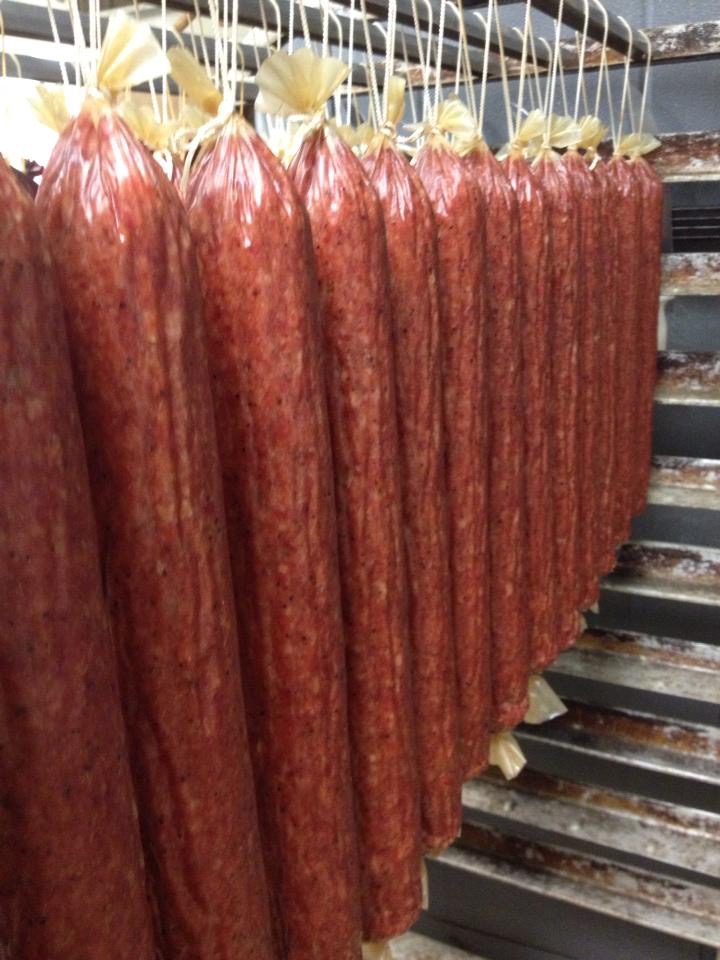
    After the sausage is stuffed in the casing, you have a long tube of sausage that looks like this.


    If we left the sausage like this, it would be very hard to handle in getting it smoked and cut into serving-size pieces. So, we linked it.

    To link the sausage, we pinched the sausage casing and twisted it. You have to alternate the direction that you twist the casing or you will untwist previous links. In big commercial sausage plants, they have machines that link the sausage as it comes out of the stuffer.

    I have a video of linking, too.


    This is what the linked sausage looked like. This was some of our jalapeno, cheese recipe.

    We allowed it to rest in the cooler overnight. That gave the protein a little extra time to soak up the flavors of the spices.


    The links all stay attached to each other until we cook it. When it’s cooked, the sausage links are hung over a metal stick and hung in the smoke house. In the smokehouse, they are cooked with heat and smoke is applied to give the sausage that nice smoky flavor. Yum.


    This is a picture of a couple of students at a processed meats workshop from about 5 years ago. They are not my students, but I think that they are now both gainfully employed. You can see the linked sausage ready to go in the smokehouse.

    This is a picture of our finished product. It was quite tasty!

    This is just the tip of the iceberg when it comes to sausage making. There are so many other neat things to talk about, like fermented sausage, different casings, hot dogs, canned sausage, pickled sausage, and other cooked meat specialties, but I guess that will all have to wait for another day’s post.

    Thursday, September 8, 2011

    What is really in processed meats?

    While you are reading the first few sentences of this post, imagine (better yet, sing) an accompaniment of dooming background music. Think Darth Vader. I am going to talk about what is in processed meats (this is a good place for the ‘dun dun duh’ part of the song). Everyone knows the old saying about the only two things you don’t want to see being made are… sausage and legislation. And, we all learned from those menacing little raccoons on ‘The Great Outdoors’ that hot dogs are made from lips and assholes. (dun dun duh).

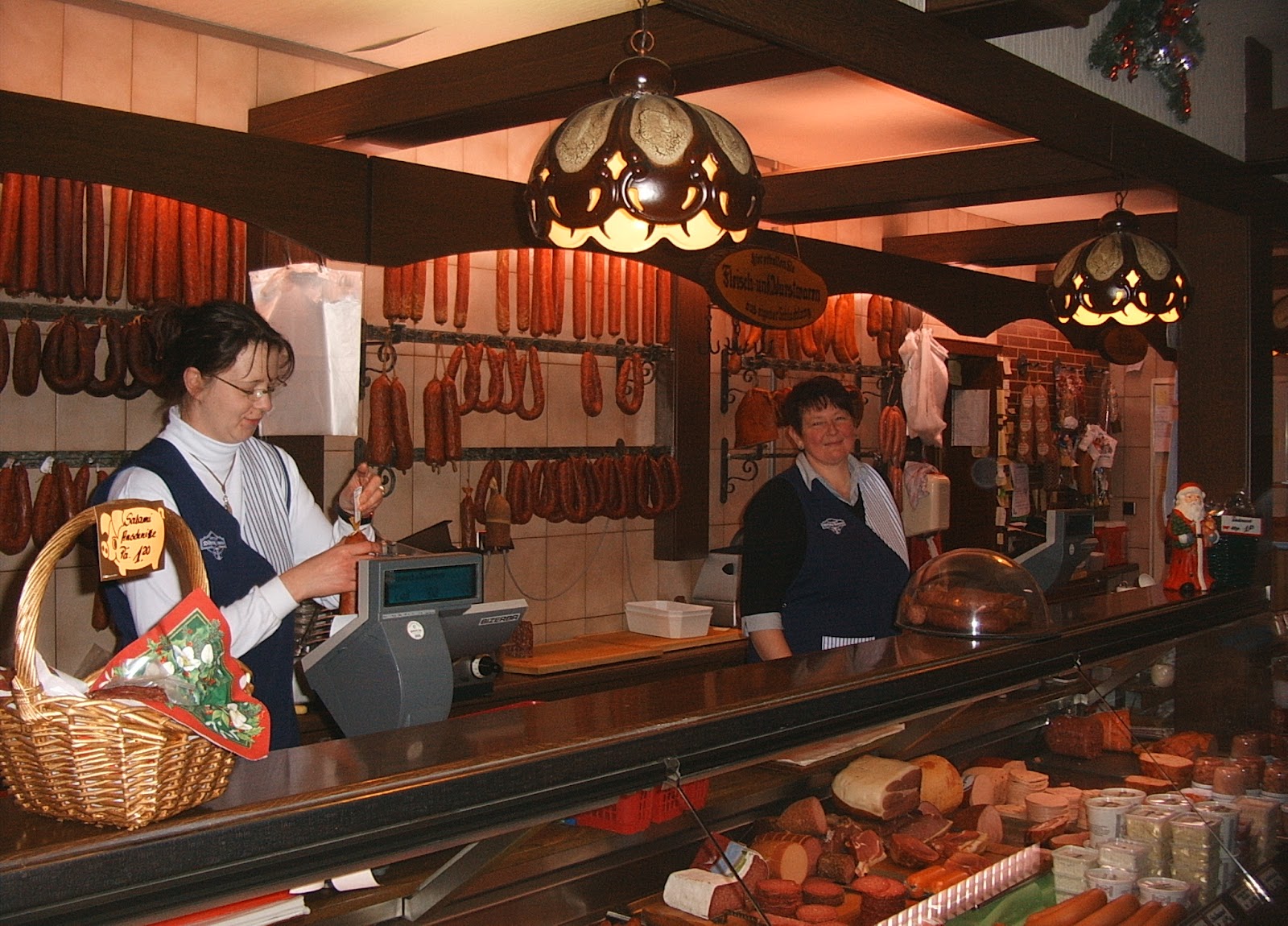
    Some processed meats in Germany from a trip
     several years ago.
    Well, as entertaining as the raccoons and the jokes about law-makers may be, they are wrong about processed meats (now imagine light-hearted back ground music). Processed meats are an inexpensive source of protein. They are safe and convenient. They are NOT made with lips and assholes (sorry about the language, Mother) unless it’s on the label.

    In the US, we have some of the most stringent food labeling laws in the world. If an ingredient is in a food, then it is on the label. (Side note: I worked at a grocery store in college, and occasionally we had to package ‘real Mexican Chorizo’. Being a meat academic, I read the ingredient statement on the label. Do you really think this company would let us know that their product contained pork salivary glands if they didn’t have to? Uh. No.) If you want to know what is in a certain processed meat, look on the label. If it says ‘Beef’ or ‘Pork’ like most processed meats do, it is only skeletal meat (muscles used to move the bones around). As of right now, that means beef products may contain lean, finely textured beef. Any organ meat (hearts, livers) have to be listed on the label. Lips and ass holes really don’t make very good sausage, anyway.

    So, why are processed meats inexpensive? Well, not every bit of a beef or pork carcass will make a good steak or roast. Sometimes the pieces are too small, and sometimes it is too tough to be eaten without being ground up. Those pieces are combined and ground up. Processors add other ingredients like salt and spices for flavor and texture. They are adding value to the low-cost parts and giving us a great tasting, inexpensive source of protein. Processed meats are the only source for protein for kids from some families because it is all they can afford.

    Furthermore, lots of processed meats (hot dogs, bologna, and deli meats) are pre-cooked and can be eaten straight out of the fridge*. They are quick and easy. Any meat product that is ‘ready-to-eat’, meaning completely cooked and ready to be served to the consumer without any further preparation, is subject to extra regulations by USDA. They have to show how they are keeping their product safe, they may add extra, bacteria fighting measures to the process, and are subject to extra bacteria testing. It is safe stuff.

    Some people worry about nitrite in processed meats. Nitrite is a key ingredient that gives cured meats the flavor and color we have become accustomed to enjoying. Think pink hams and hot dogs. Yum! Also, nitrite prevents the growth of a nasty bacteria Clostridium botulinum, the one that causes botulism.

    Did you know that you get more nitrite from green, leafy vegetables than from processed meats? Actually, the body makes nitrite using saliva combined with these vegetables because it needs it. The body uses nitrite to perform all kinds of functions from regulating blood pressure to helping heal wounds and brain injury after a stroke.

    The folks at the American Meat Institute did an interview with a friend of mine, Jeff Sindelar at the University of Wisconsin about sources of nitrite in the diet. His main research focus is on nitrites in processed meats.

    There are some very scary claims out there linking hot dogs with an increased cancer risk. Although these claims are recurrently cycled on the news, the data that they are based on is from over 40 years ago. They claim that the nitrite in processed meats (hot dogs) is a carcinogen. There is a researcher at the University of Texas named Dr. Nathan Bryan who studies the effects of dietary nitrite on the human body, and he says that current research not only found no cancer risk with nitrite, but also found health benefits. Basically, current science says, “Don’t be afraid of hotdogs!”

    Also, I have written a post about nitrite and one about making sausage in our meat lab.
    Besides, do you really think ESPN would put an international broccoli eating competition on TV?

    *(Side note: Just to be extra safe, pregnant women should not eat hotdogs and deli meats, without heating them up first, because of an abortion-causing bacteria rarely found in ready-to-eat deli meats and hotdogs)