What if I told you that twice a day, I tie my four-year-old to a chair and leave her there for an hour?
No matter how she pleads or cries or protests, she has to be tied down. Some days I strap her to a chair for 9 hours or more.
Before you call Child Protective Services, think about a car seat. It is against the law for me to transport my small child anywhere without strapping her into a car seat. She may not like it, but its best for her.
Everyone understands the dangers of not using car seats. No one will argue that they are not needed to keep our children safe. People understand how dangerous car wrecks can be. We haven’t always used them (my parents weren’t strapped in car seats), but people now agree that they are needed to keep kids safe.
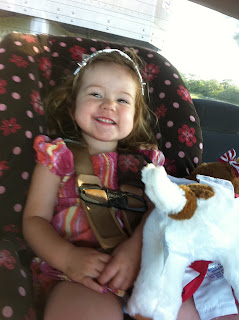 |
| Happy kid... tied to a chair |
People don’t know much about pig farming.
Most people think of Wilbur or Babe when they think of pigs on farms. Cute little pink pigs that make smart-alecky remarks to the sheep. But, that’s not reality. Real pigs are much different.
- Did you know that grown sows (momma pigs) can weigh as much as 500 pounds?
- They are huge animals. They may stand 4 feet tall.
- They can be very dangerous animals. Pig farmers can tell very scary stories about a pig hurting or even killing someone.
There has been a lot of news in social media and on the internet about
gestation stalls, or maternity pens, used in the pork industry.
Several food companies and restaurants have declared that they will be phased out in the next few years and some states have even passed legislation banning them.
Most people know very little about pork production and why gestation stalls are used. People see pictures and hear terrible stories about farmers ‘abusing’ pigs and think, “Wow, how can we let this happen?” The problem is that we are not hearing the whole story. So, I decided to write a post about them, to help explain.
What are gestation stalls?
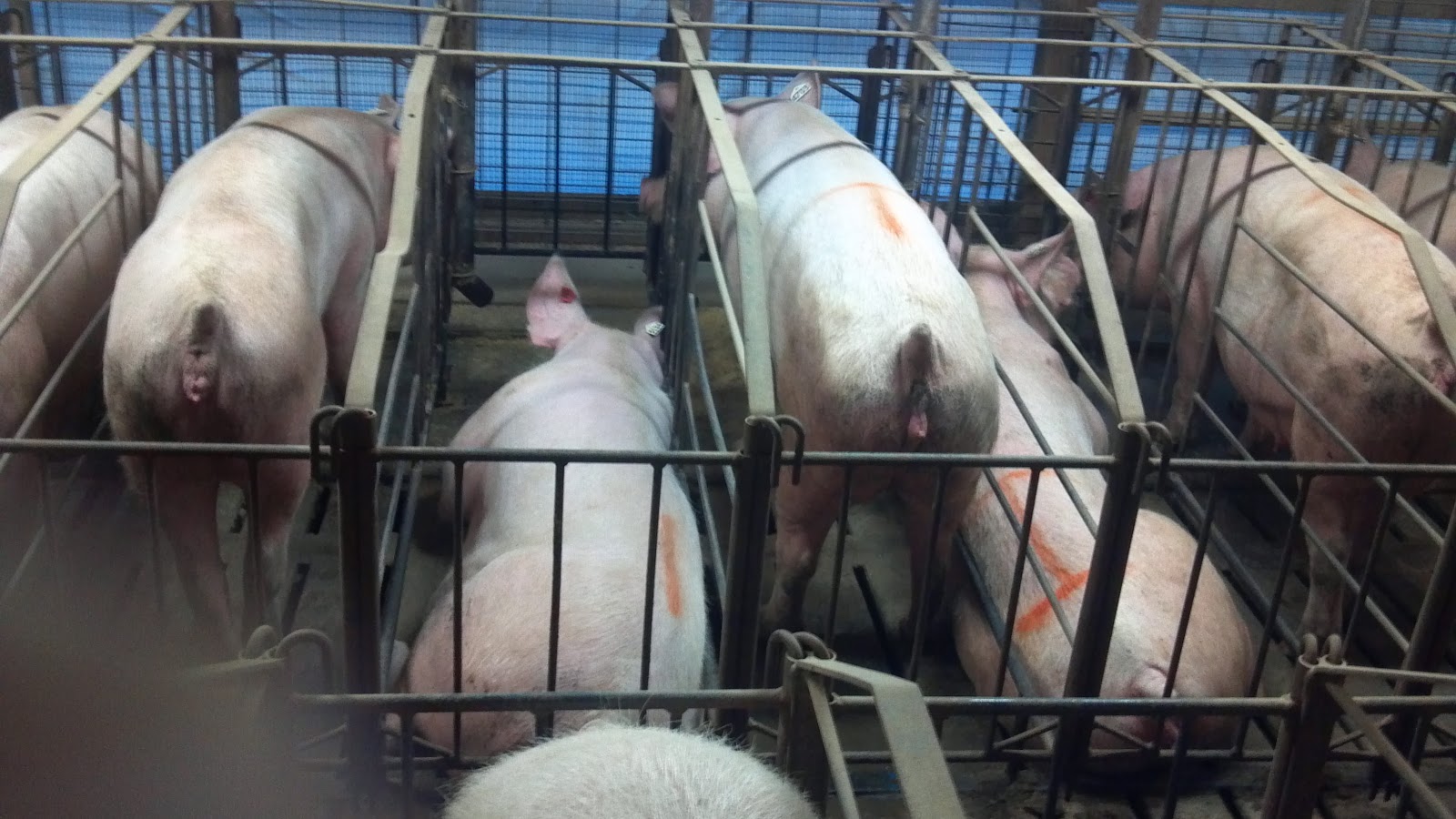
Gestation stalls are small pens that farmers put sows (momma pigs) in while they are pregnant. They provide each pig with a specific amount of food and all the water she wants, but there is not a lot of room for her to move around. They can lie down, but not turn around. They are artificially inseminated (bred to the boar) in those pens and stay there until they are about to have their babies. Then they move to a different type of pen.
 |
| Photo courtesy of Standing Oaks Enterprises. |
A friend of mine who is a pig farmer in Ohio sent me these pictures of pigs in gestation stalls on his farm, Standing Oaks Enterprises. You can check out his blog at
Acorns for Thought.
Why do farmers use them?
First, they use them to protect the pigs from each other. Just like people, pigs pick on each other. If you have a group of pigs together in a pen, they will fight to establish a hierarchy, to determine who is the boss. In the case of sows, some will become ‘bully sows’ and will literally fight and pick on inferior sows until they are physically separated or one dies. These pigs stand waist-high and may weigh as much as 400 or even 500 pounds. A 200-lb man is no match for them. Fighting sows are very dangerous.
Second, farmers must control how much feed the pigs eat. Also like people, pregnant sows are very hungry. But, unlike most people, they don’t know to control how much they eat to keep from getting obese. If allowed to eat all they wanted, the pigs would be morbidly obese, they would shorten their lifespan, and it would be wasteful. If the sows were mixed, some sows would hog (no pun intended) all the feed and overeat, while others would starve. So keeping them separate allows the farmer to feed each pig exactly what she needs.
 |
| Photo courtesy of Standing Oaks Enterprises. |
Another pic from Standing Oaks. You can see the pigs feed in bins above their stalls.
Since I've been working on this post, I participated in a
radio show with a pig farmer from Missouri,
Chris Chinn. She was asked about gestation stalls and had a couple of points I wanted to share. She said that her farm used to use group housing and that the bully sows ate too much and had big babies and trouble in labor. She also said that the weaker sows had small, unthrifty babies. When they switched to gestation stalls, they found that they used less medicine because the sows didn't injure one another fighting.
Right before the sow has her babies, the farmer will move her into a
farrowing crate. These are pens that are large enough for the sow to stand up and lie down, but she has to do it slowly. Remember these sows can weigh as much as 500 pounds. Their piglets may only weigh 3 or 4 pounds. They can walk soon after they are born, but not very well. If the momma pig lies down too quickly, she could squish her babies.

This photo is from Flikr, used with permission |
|
This is a picture of a sow with her babies in a farrowing crate. See how little they are.
Research shows that there are advantages and disadvantages of using gestation stalls. One study gave pigs the choice of remaining in a group pen or in a gestation stall and found that the pigs preferred to stay in the stalls most of the time. In a
video of a farm in Indiana, the farmer has European-style gestation crates, where the pigs can choose to go in or out of the stalls. He says they stay in their stall over 90% of the time.
In response to all the pressure from food companies, some farmers have removed their gestation stalls and changed their barns to group housing. Others have installed European-style pens that give pigs a choice of where they can be.
Big changes in animal housing need to happen slowly.
Don’t think that we can just ban stalls and walk away feeling good about our animal welfare practices. Pigs and people will suffer if we don’t find acceptable alternatives.
The American Veterinary Medical Association (AVMA) put together a task force to address sow housing that included several vets and a representative from HSUS. The
task force concluded that any sow housing systems had advantages and disadvantages, and that farmers and animal scientists should work together to retain the advantages of the current systems and improve on them.
I hope that veterinarians, farmers and food companies can work together to determine what is truly best for pigs. I don’t think anyone has an easy answer right now. Even the animal welfare experts say that there are no easy answers when it comes to housing pigs.
I think this quote from
Dr. Temple Grandin is very meaningful, “
Nature is cruel, but we don’t have to be.” She said it many times. Animals are cruel to each other. Farmers do their best to keep animals happy and healthy. Just like parents with car seats.
Here are a few more resources about gestation stalls and pig housing.
· A good
Q and A about gestation stalls and their history.
· A nice video about
modern hog farming, including gestation stalls.
· A good video from
Humane Watch about pigs and maternity pens.
· The report from the
AVMA task force on sow housing.